Every step of the
sample life cycle
From the parcel arriving at your gate to the certificate a customer scans a QR code to verify. The rules that keep a lab defensible are enforced by the server and the database — not by a screen that can be skipped.
Seven things that are hard to copy
Everything below this section is the baseline — intake, analysis, resources, reporting. Any credible LIMS has those. These seven are the ones worth choosing us for, and each names the mechanism rather than the benefit, so you can check it. Two of them — atomic ULR allocation and server-side GUM uncertainty — are things we could not find named as a mechanism, rather than a feature-list checkbox, on any other LIMS vendor’s site we compared against.
The server refuses work that would fail an assessment
A lapsed instrument calibration, an analyst not signed off on the method, a blocked QC run, a failing result with no attached evidence — each is refused when the save is attempted, not flagged in a screen a busy lab learns to click through.
Thirty-four distinct refusal codes run before a result is accepted.
NABL ULR numbers allocated by the database
Your accreditation certificate number, the two-digit year and an eight-digit running number, composed in a single atomic statement in the format of NABL’s June 2026 clarification. Two analysts issuing at the same moment cannot receive the same number, the series only moves forward, and no ULR is issued at all without an accreditation certificate on record.
One series per certificate, restarting each 1 January; works for TC, CC and RC certificates and the new NABL certificate format; an amended report may keep its original ULR.
The calculation is part of the record
Analysts enter variables, not answers. The formula runs server-side on save with significant figures, rounding mode and GUM expanded uncertainty, and writes an execution log that cannot be edited or deleted.
Approved formulas are immutable at database level — cloning is the only way to change one.
A working lab on day one, not a configuration project
Choose your discipline at signup and the departments, test methods, instruments, registration fields and regulatory limits for it are already there — as editable templates, not as a blank system with a manual.
15 disciplines provisioned; water alone seeds 19 methods, 11 instruments and 18 limits.
Indian regulation as the default, not a localisation
CGST, SGST, IGST and UTGST with HSN and SAC codes, TDS and TCS, and GSTR-1 export in the format the GST offline tool accepts. Twelve Indian regulatory bodies seeded alongside fourteen international ones.
Built in from the first migration, not bolted on for one market.
The communication hub is free, on every plan
Channels, direct messages, files and polls, with sample, job and report cards shareable straight into a conversation. It is a core module — not an add-on, not a seat charge.
Enabled for every tenant regardless of plan.
Automation earns trust before it acts, not after
A deterministic rule engine — no LLM, no black box — proposes specific decisions, such as who should take a job or what the morning plan should be, and writes every proposal with its reasons to a decision ledger beside the human decision. Nothing in the lab workflow acts on its own: a person approves, and timers only remind.
Every automated proposal is a sealed ledger row with its reasons; autonomy is something a lab switches on later, never the default.
Everything a lab actually runs on
The eight areas below are what any LIMS has to cover. Pick one to see what is in it, and which industries and standards depend on it.
Intake & sample life cycle
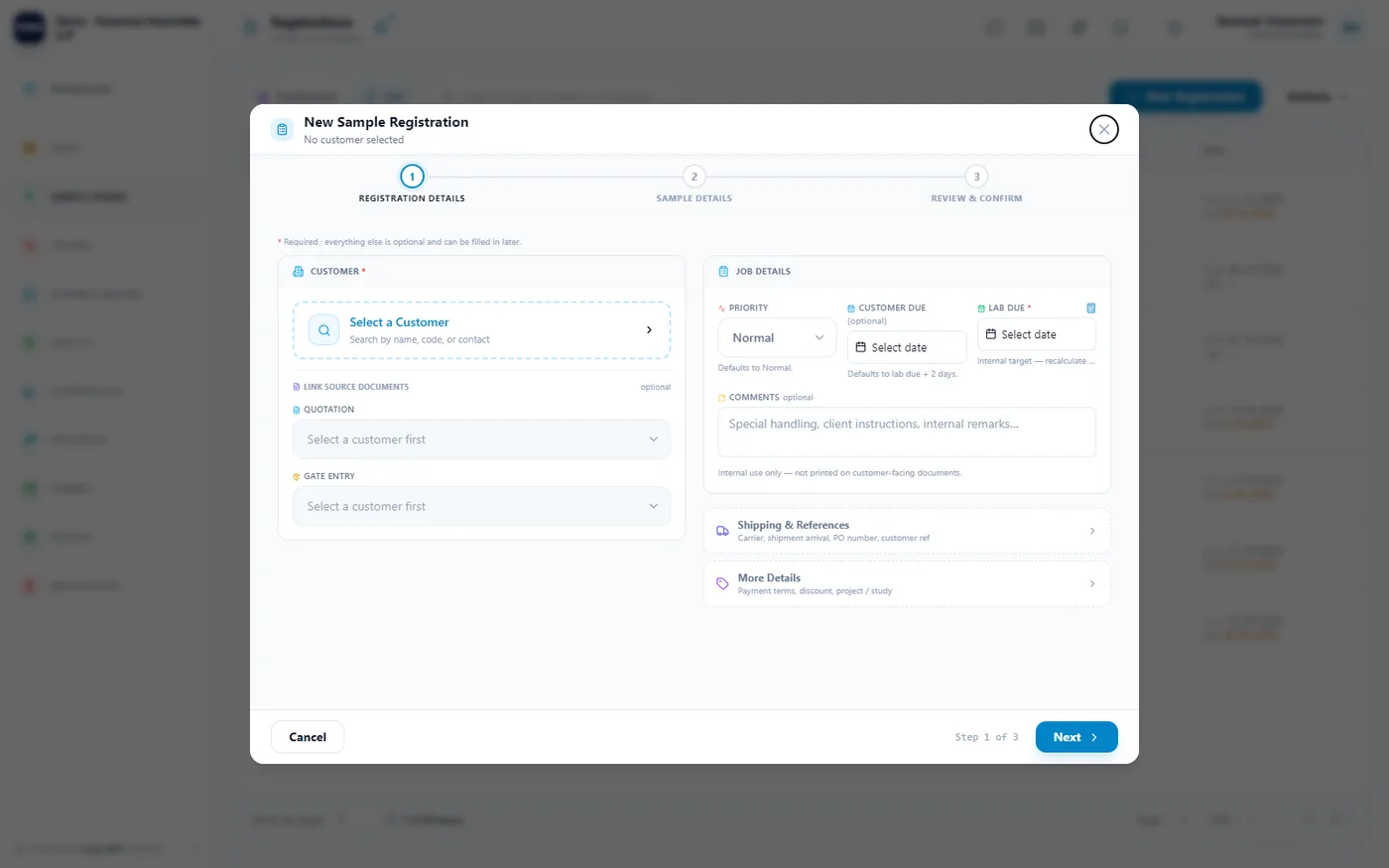
Everything before the bench. Quote, receive, register, route, store — with custody recorded at every hand-off.
- 1Quotations to jobsBuild a quote with items and samples, get it approved, convert it into live work.
- 2Gate entryLog the physical parcel the moment it arrives, before anyone has time to register it.
- 3Registration wizardBarcode and label generation, test selection, domain-specific intake fields.
- 4Chain of custody & storageEvery transfer logged; storage locations cannot be nested into themselves.
- 5Routing & feasibilityAuto-route by matrix, type or customer — and check the lab can actually take the work.
Analysis & results
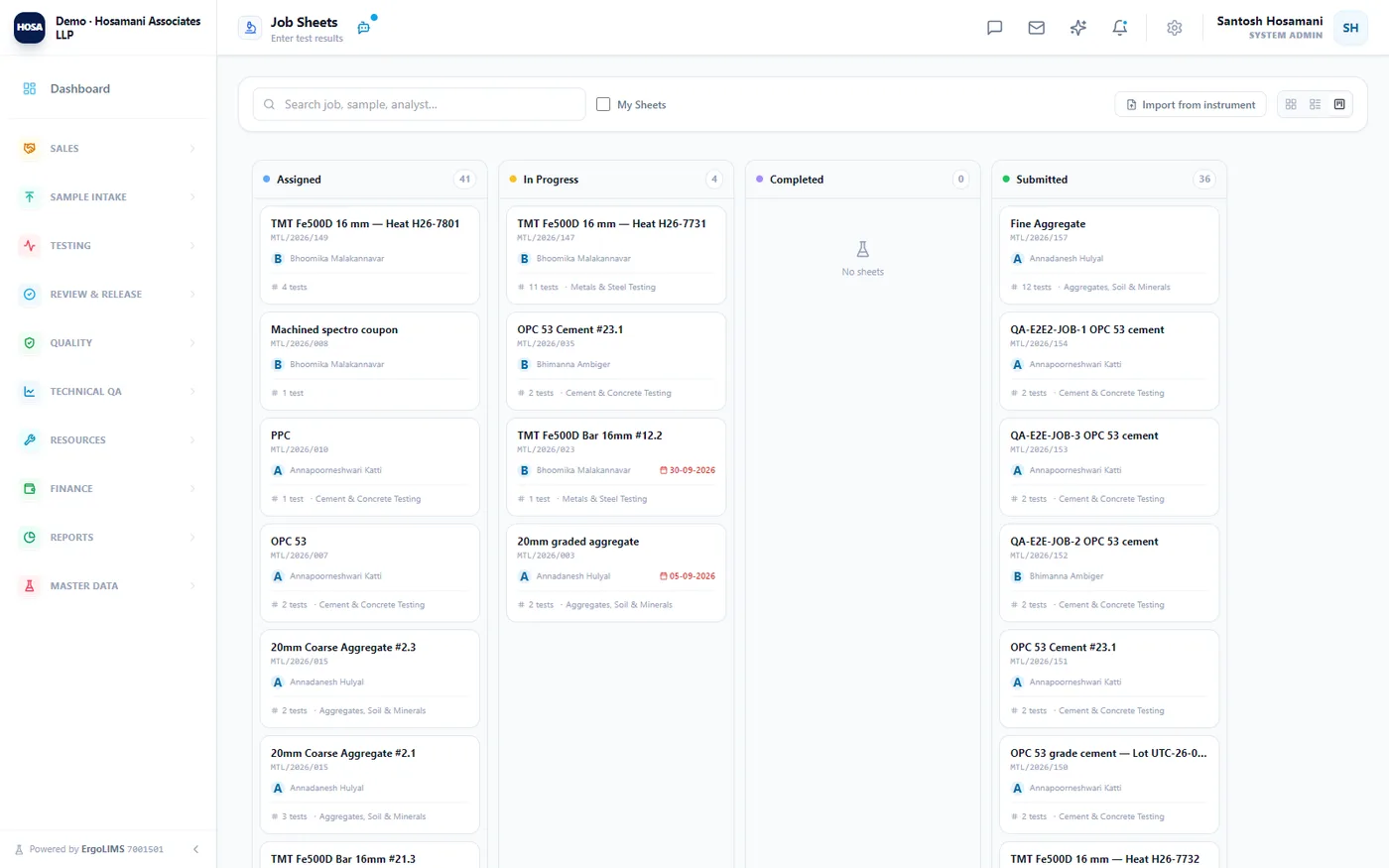
The core, built around ISO/IEC 17025 clause 7. Thirty-four distinct server-side refusals run before a result is allowed to exist.
Expired calibration, unauthorised analyst, blocked QC run, missing OOS attachment, version conflict — each refuses the save server-side.
Analysts enter variables, not answers. Significant figures, rounding mode, GUM uncertainty, 4PL/5PL calibration curves. The execution log can never be edited or deleted.
Department review, then final verification. After release, results are amended with a reason code and re-issued — never quietly deleted.
Out-of-specification results raise an investigation with defined closure criteria before the report can move.
Twenty-six specification-driven worksheets for cement, concrete, steel, aggregates, soil, bitumen, microbiology and chemistry. You enter the load or the reading; the IS acceptance rule is computed on save. Cube sets, test ages, Excel cube import and a Tests Due Today list.
Quality control & metrology
The statistics an assessor asks for, computed in the system that holds the data — not in a spreadsheet on someone's desktop.
- 1Westgard multi-rule QC1-3s, 2-2s, R-4s, 4-1s, 10x on control charts, with rolling limits and run-blocking.
- 2Capability studiesCp, Cpk, Pp, Ppk and sigma level per parameter.
- 3Gage R&RMeasurement system analysis by ANOVA and by average/range.
- 4Method validationLinearity, LOD, LOQ, repeatability, reproducibility, robustness — recorded as studies.
- 5Measurement uncertaintyBudgets with type A and type B components and a stated coverage factor.
- 6Proficiency testing & CRMsPT/ILC schemes with z-scores, plus a reference-material register with traceability chains.
Instruments, stock & people
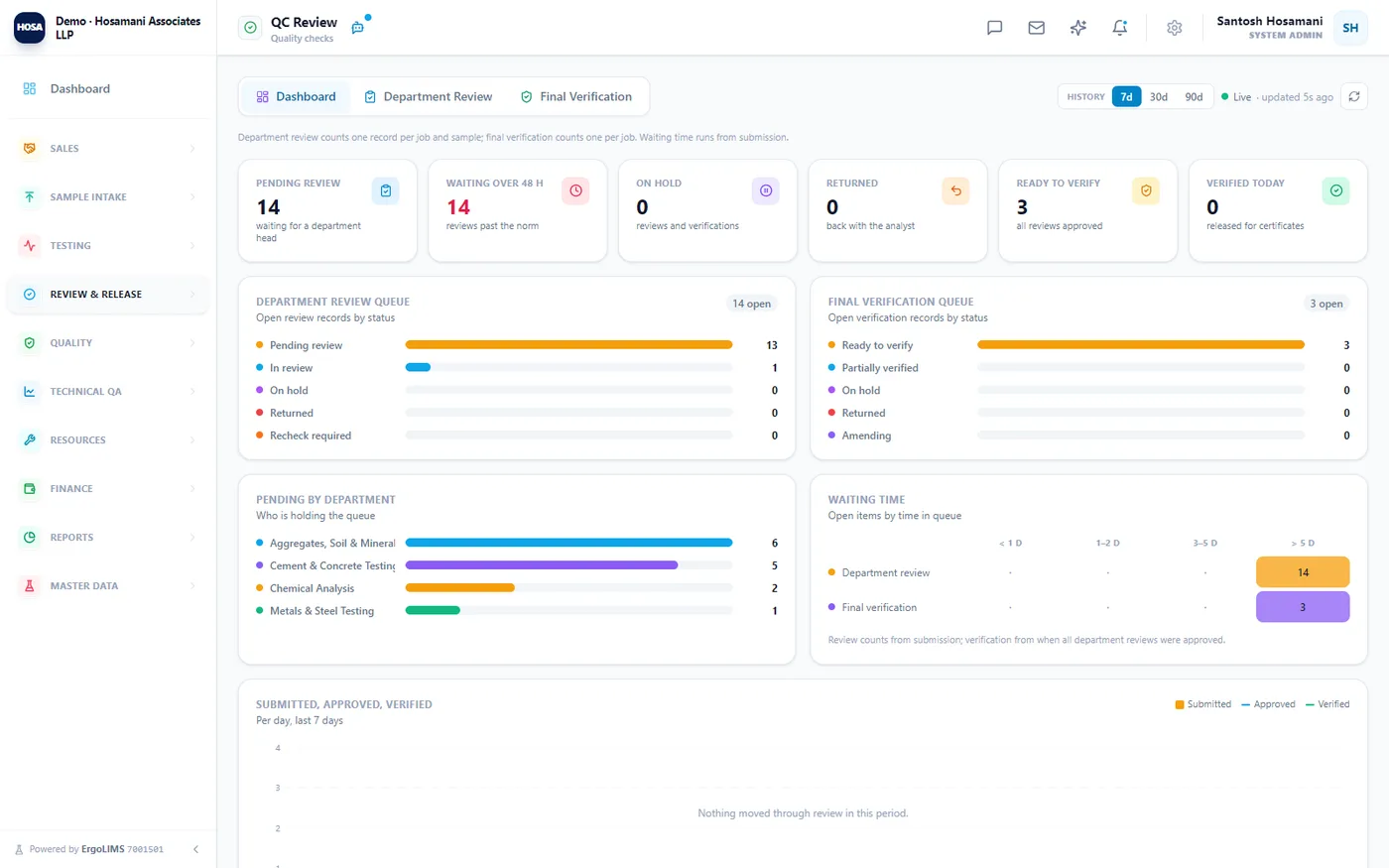
Clause 6 in full — equipment, consumables and personnel. Every result traces back to the instrument, the batch and the person who was cleared to do it.
- 1Calibration & maintenanceSchedules, service and verification logs, certificates — and automatic lockout the day calibration lapses.
- 2Instrument bookingDouble-booking is prevented by the database itself, not by a warning message.
- 3Inventory with FEFOItems, containers, stock levels, transactions and reagent usage recorded against the test. Purchase orders and expiry tracking included.
- 4Competency registerSkills, per-method authorisations with expiry, certifications, training records, and who may operate which instrument.
- 5Impartiality controlsBar a named analyst from a named customer — ISO/IEC 17025 §4.1, enforced at result entry.
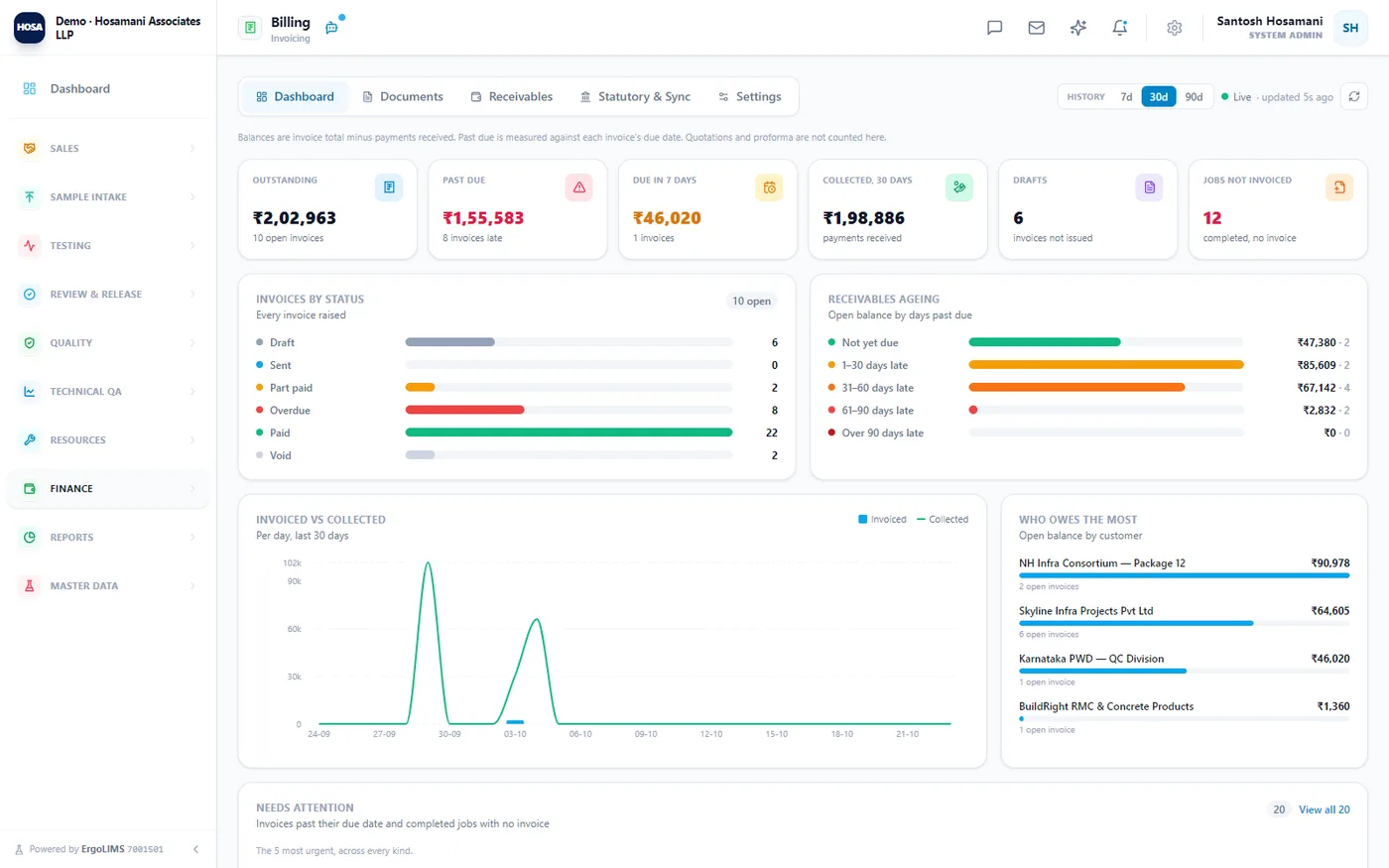
Certificates, portal & billing
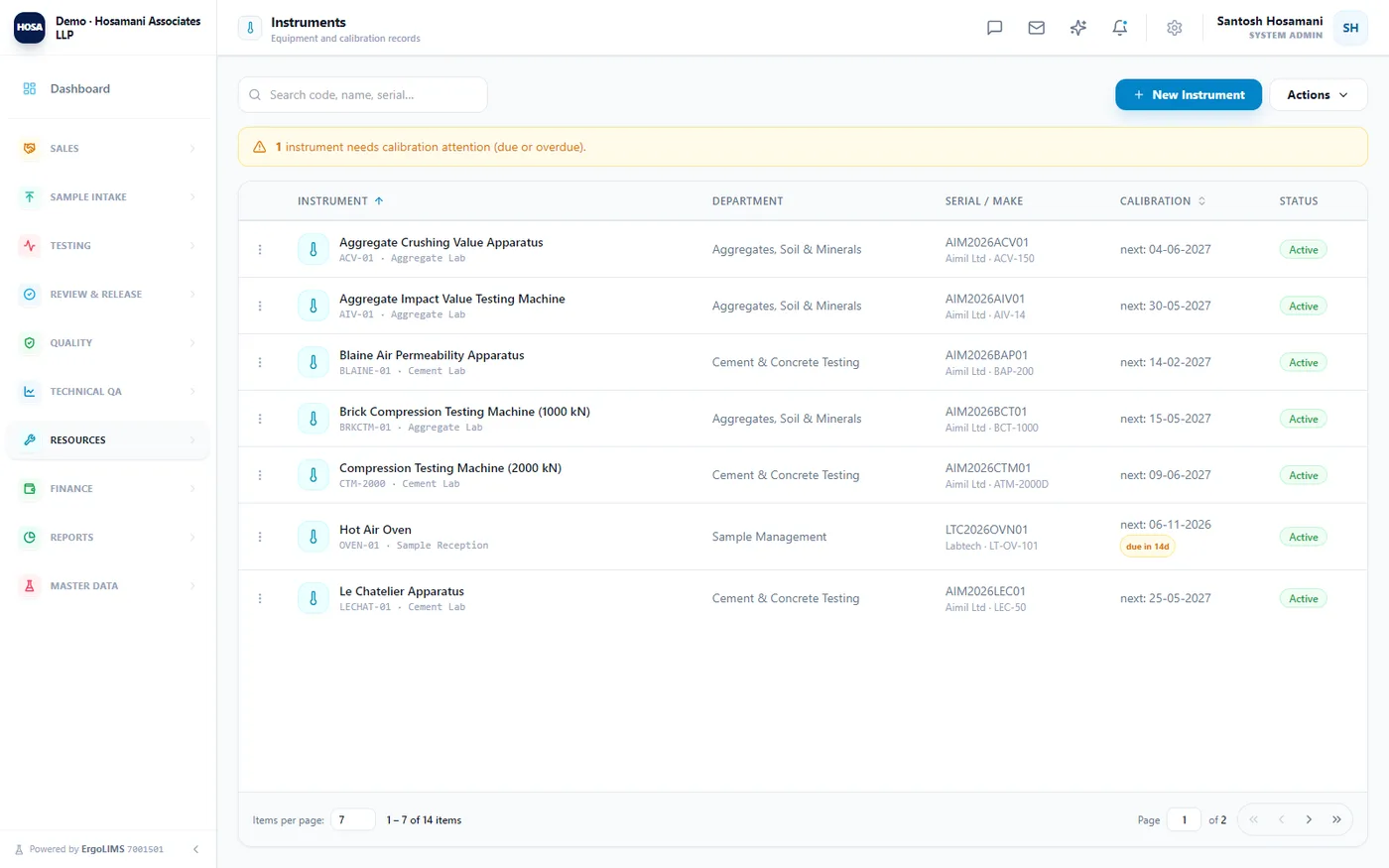
The deliverable and the money behind it. Designed in the product, verified by the public, invoiced under Indian tax law.
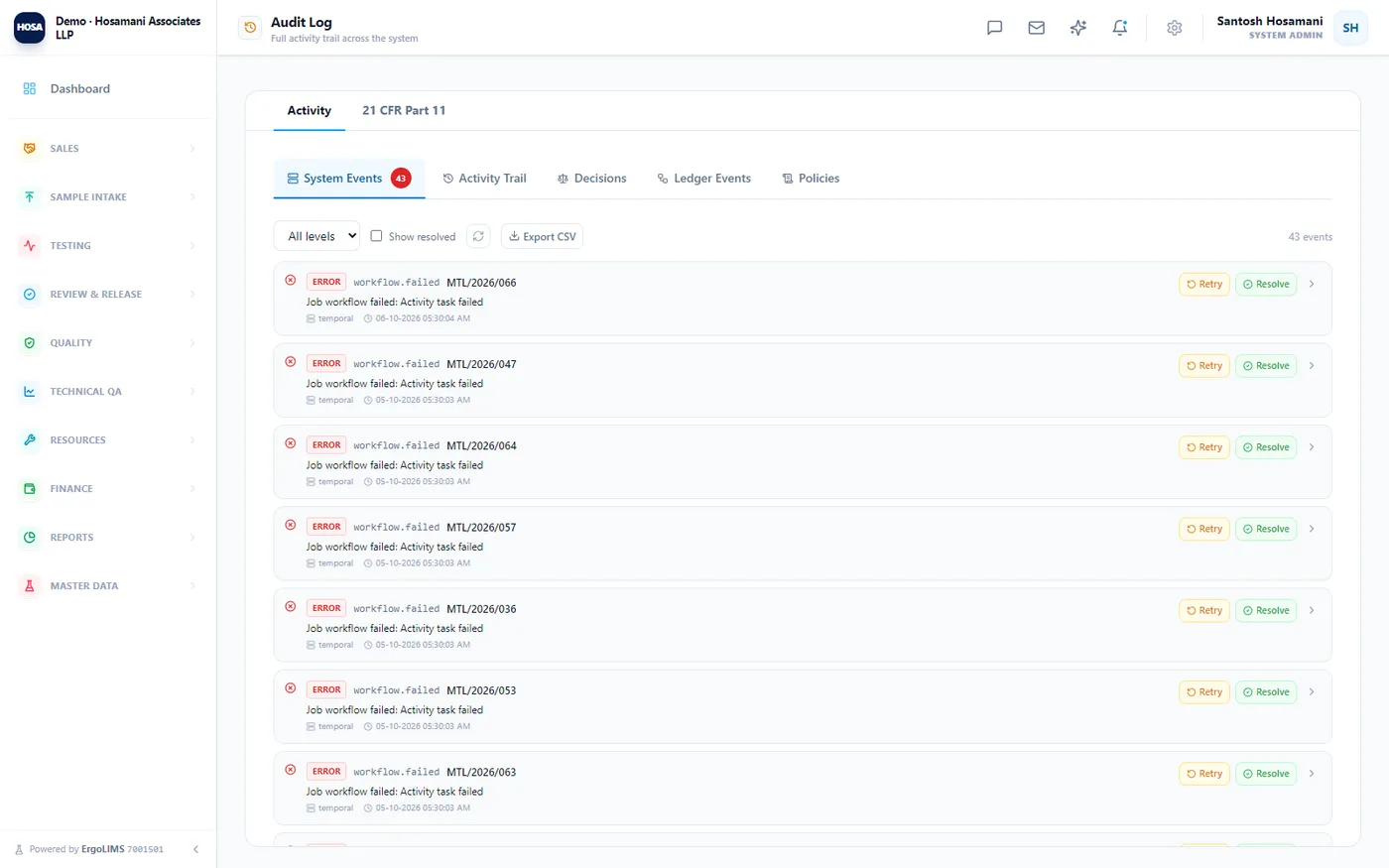
QMS, documents & data integrity
Built for the assessor. The quality system is not a folder beside the LIMS — it is the same system, on the same audit trail.
- 1Document controlDraft → effective → obsolete, automatic numbering, review-due alerts, check-out/in, e-signed multi-step approval and retention — and an author can never approve their own document. Docs and Sheets editors save on the lab’s own server, so an SOP can be written, reviewed and made effective without leaving the system.
- 2CAPA, NCs, complaints, auditsInternal audit findings link straight to CAPA. Complaints and non-conformances carry a full investigation lifecycle.
- 3Management reviewISO/IEC 17025 §8.9 cycles with inputs, actions and sign-off, feeding the next audit programme.
- 4Immutability in the databaseTwelve triggers stop edits and deletes on the activity log, the record audit trail, formula executions, approved formula definitions, domain events and the decision ledger. Each row is sealed with its own SHA-256.
- 5Part 11 controls & privacyElectronic records and signatures with identity challenge and reason capture, a Part 11 console for pharma labs, versioned retention policies and legal holds. A DPDP subject-request console is on the roadmap.
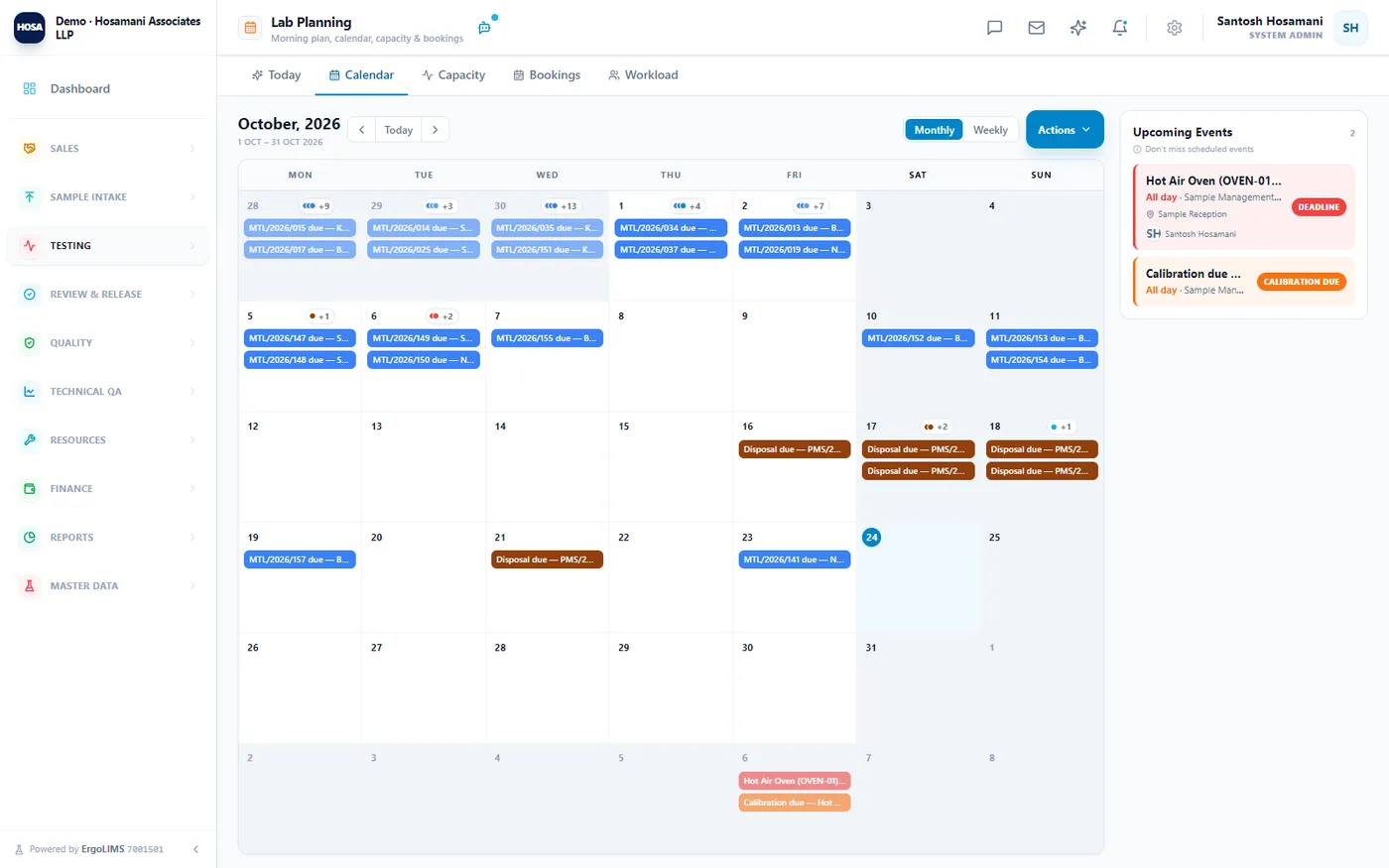
Planning, workload & calendar
Who is overloaded, what is about to breach, and what the lab is doing today — on one board.
- 1Analyst capacity boardConfigured hours per analyst against real assigned work, with a priority queue and a TAT-risk list.
- 2Leave-aware redistributionLeave requests feed the board; work reassignment is logged every time it happens.
- 3Lab calendarLab-defined event categories, online or on-site meetings, recurrence rules, and attendees picked from your LIMS users.
- 4Reminders that fireDispatch is idempotent and logged — a reminder is sent once, and you can prove it was sent.
- 5Subscribe from Outlook or GoogleA read-only .ics feed per user, so the lab calendar lives where people already look.
- 6Holiday-aware turnaroundDue dates count working days only, skipping your configured week and recurring lab holidays.
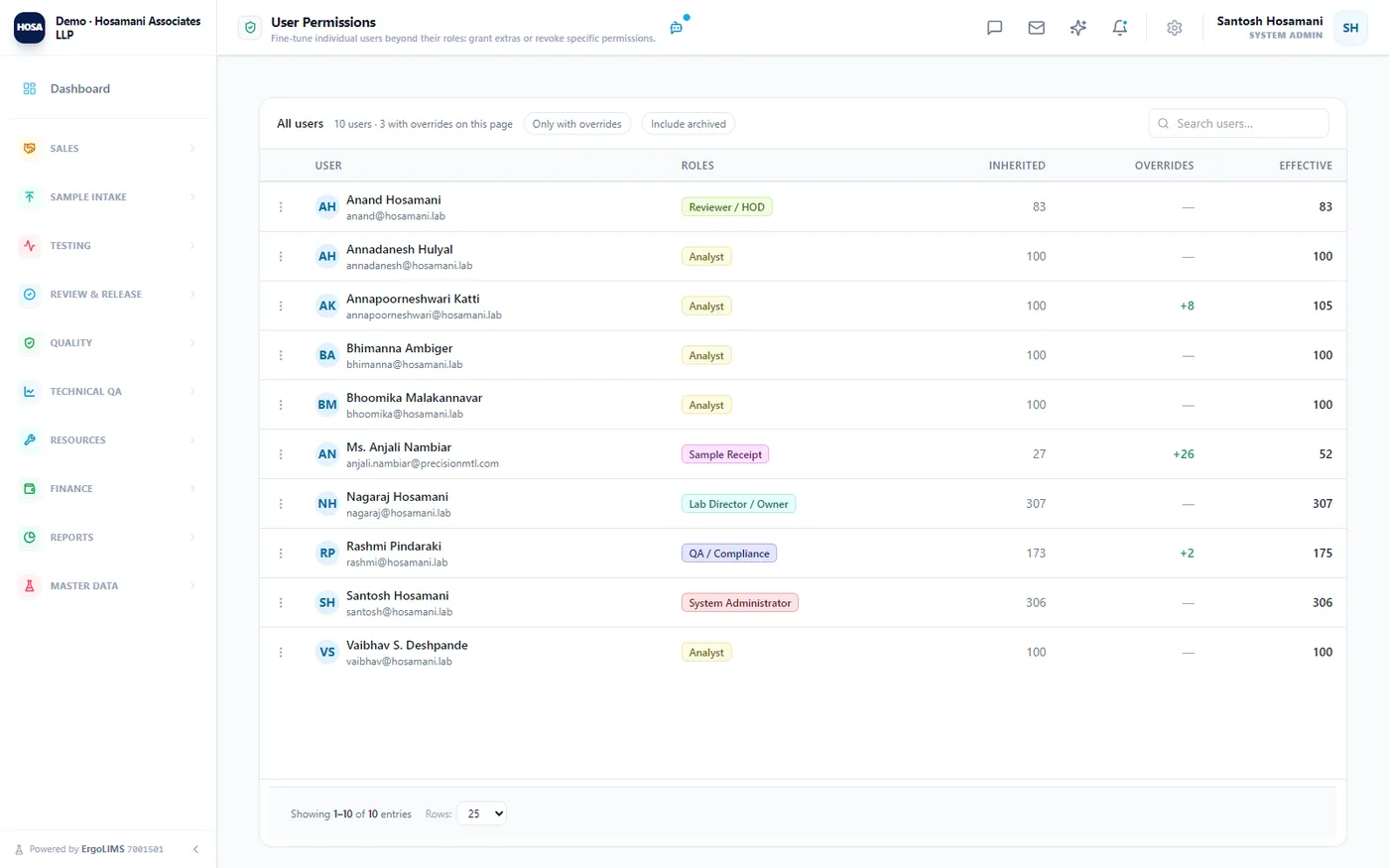
Platform, collaboration & integrations
The parts that make the rest of it usable for a real organisation — access control, communication, other systems, and your data's long-term safety.
8 areas — pick any one above. Or search the module index.
Would you rather just see it?
26 screens from a demonstration tenant, plus the full dashboard end to end.
An in-product expert on your lab
New analysts ask the same questions for months. Which method applies to this matrix? What is the acceptance limit on this product? Which revision of the SOP is current? The answers already exist — in your SOPs, your method master and your validation records — they are just slow to find.
ErgoSage compiles exactly those documents into an assistant that answers in one place, and shows the source for every answer it gives.
Being built into ErgoLIMS now — it is not in the product today, and it is not part of what you would be paying for until it ships. ErgoSage is available now as its own product and can be deployed alongside your lab today.
Answers with the source attached
Every answer cites the SOP, method or record it came from, so an analyst can open the source and check it rather than taking the answer on trust.
It does not decide anything
The expert answers questions. It does not approve results, release reports or change records — the authority checks that stop a person doing those things are not delegated to it.
Self-hosted, like the rest
ErgoSage runs on your own infrastructure. Your SOPs and validation records do not leave it to answer a question about them.
Your own AI keys
Bring your own model provider and key. There is no shared tenancy and no vendor sitting between your documents and the model.
Does it do the thing you need?
All 52 modules in the catalogue. Search for the thing your lab actually needs — each one tells you whether it is available now or coming soon.
Core · 9
Gate entry, job registration, chain of custody and storage.
Test methods, parameters and result entry with server-side guards.
Certificate generation with QR verification and revocation.
Customers, contacts, addresses, commercial terms.
Register, calibration and PM records, lockout on expiry.
Reagents, consumables, lots and stock alerts.
NC lifecycle with CAPA tracking.
Roles, 263 permissions across 84 resources, per-user overrides.
Append-only trail in Postgres, enforced by database triggers rather than application code.
Compliance & quality · 18
Acceptance limits per product and test, with approval and versioning.
Linearity, recovery, LOD/LOQ and precision records.
MU budgets per method and analyte.
Out-of-specification Phase 1 and Phase 2 workflow.
Corrective and preventive actions with effectiveness checks.
Customer complaint tracking (ISO/IEC 17025 §7.9).
Audit programme with a finding lifecycle (§8.8).
Review records with tracked actions (§8.9).
PT schemes and inter-lab comparisons with z-scores.
CRM and RM register with traceability and expiry alerts.
Post-verification amendments as a new report, original retained (§7.8.8).
Identity challenge at signing, with the stated meaning recorded.
SOPs and policies on a Draft → Effective → Obsolete lifecycle.
One screen for the Part 11 controls: the trigger-enforced audit trail, e-signature records and their review. For pharma and GMP labs; it is a tool to support compliance, not a certification.
Data-subject registry and rights requests. Retention policies and legal holds already ship under Retention & backup.
GMP change management: propose, assess, approve, implement, verify. For pharma and GMP labs.
Allergen master, sample declarations and COA allergen statements. For food labs.
External lab referral and result tracking (§6.6).
Operations · 16
Lab capacity and work scheduling.
Jobs, calibrations and events in one calendar with an iCal feed.
Turnaround agreements, escalation timers and breach tracking.
Calculation formulas and constants, executed server-side at result entry.
Field collection with GPS and in-situ measurements.
Leave requests and approvals, with workload redistribution.
Branches, collection centres and satellite labs.
Customer projects and sites, a cube register and project-scoped reports for materials labs.
Specification-driven electronic worksheets with IS acceptance rules computed on save, and the daily Tests Due list.
Case intake, exhibit custody, DNA runs and kits, allele-frequency and elimination databases, statistics, court diary and two-person disposal. For forensic laboratories.
Experiments, observations and protocols, versioned and signed. For pharma and GMP labs.
Study register, pull-point schedules and data capture against the study protocol. For pharma labs.
EM zones, sampling points, results and exceedance non-conformances. For pharma and GMP labs.
Quarantine, release and reject workflow with batch COA. For pharma and GMP labs.
Analyst workload, the morning plan and assignment proposals, with every proposal explained before a person approves it.
Enquiry and lead capture, including a web form for your site, converting to quotations with approval.
Analytics · 2
Levey-Jennings charts with Westgard rules that can block a run.
Capability studies (Cp/Cpk) and Gage R&R.
Billing · 3
Quotations, proforma and tax invoices, combined bills, credit notes, receipts and refunds, a ready-to-bill list, GSTR-1 and Tally export.
Live two-way sync with Tally, SAP Business One and QuickBooks. GSTR-1 JSON and Tally XML exports ship today under Accounts & billing.
Invoicing before the certificate is issued.
Communication · 4
Channels, direct messages, files and polls — free for every lab, on every plan.
Email campaigns to customers and prospects who opted in, lists from your LIMS data, templates, triggers and follow-ups that become enquiries.
Connect the lab’s own WhatsApp Business number and templates for report dispatch and notifications.
Bulk and transactional WhatsApp and email runs to customers, beyond report dispatch and campaigns.
A module marked Coming soon is on the roadmap and is not part of what you would be running on day one. Ask us where it sits and we will tell you.
What does this look like for your lab?
These features are the platform. Your domain decides what arrives pre-loaded — IS 10500 limits for water labs, FSSAI for food, NAAQS for environmental, IP 2022 for pharma.
Don't see a feature you need?
The platform is modular and the module catalogue is ours to extend. Tell us what your discipline needs and we will tell you honestly whether it exists, is on the roadmap, or would be new work.
Talk to the engineering team